The Cool Prion in Mad Cow Disease: Inert Matter and the Thermodynamic Trap
By GHAILAN IRGH, October 13, 2026
Author’s Note:
This framework was conceived by GHAILAN IRGH and refined with substantial assistance from AI tools (including Meta AI, Gemini, and Grok). The core insight—that an inert Level 10 aggregate cannot “infect” in the classical sense but functions as a thermodynamic/entropic trap—is human. The specific packaging presented here (the Level 1–10 continuum, explicit emphasis on the Chaperone Severing Paradox, falsifiable failure conditions, and the “Cool Prion” framing with the calibrated Dry Kanebo analogy) has not, to the author’s knowledge, been published in this exact form. Section 3.1 was upgraded from an early thermal/ice-cube analogy to a conformational-entropy description consistent with known biophysical principles.
Revision Log:
- Added Section 3.1: Cool Prions: The Entropic Trap (Not an Ice Cube) — framing the aggregate as an entropic/thermodynamic sink based on conformational constraints rather than literal temperature differentials.
- Added Section 3.2: The “Dry Kanebo” Effect: Hydrophobic Dehydration and the Dry Steric Zipper — introducing the surface-driven desolvation and molecular-level mechanism of the dry steric zipper.
ABSTRACT (150 Words)
Prion diseases ( ) are conventionally described through biological narratives of infection and replication. Emerging from a critical instigation against the paradox of “dead matter infecting living tissue,” we present a physical-thermodynamic perspective framing prion pathology not as an active biological invasion, but as a systemic bug within cellular proteostasis. We introduce a qualitative functional scale (Levels 1–10) bridging repairable, transient misfolds (Levels 1–3) to irreparable, highly crystalline aggregates (Level 10). Rather than an aggressive pathogen, acts as a passive thermodynamic sink. Rapid propagation is driven by the Chaperone Severing Paradox, where disaggregation machinery inadvertently generates reactive seeds. Based on this model, we propose testable predictions and falsifiable failure conditions, reframing prions from infectious entities to materials-science phenomena operating under physical chemistry.
1. Introduction: The “WTF” Turning Point and the Collapse of the Infection Myth
When watching standard biological animations in popular media, we are frequently presented with a dramatic spectacle: a green healthy protein is approached by a “bad” red prion protein, the green protein turns red, and the narrator shouts: “The prion is INFECTING the healthy protein!”
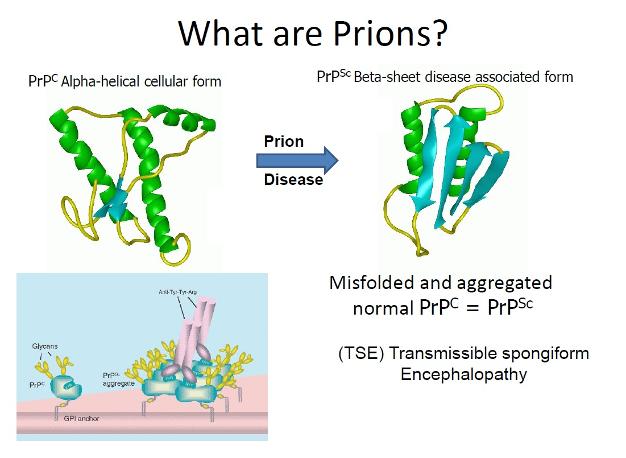
A first-principles thinker immediately questions: WTF? How can dead, inert matter infect a protein? Prions possess no DNA, no RNA, no cell wall, no metabolism, and no respiration. They are completely dead protein crystals. Derived from physical laws, this is not an “infection” in the viral sense, but rather a coerced structural misfolding driven by inert matter resting at the lowest free-energy state.
As physical objects, their properties are extraordinary:
- Extreme Chemical Durability: They resist proteolytic degradation, formalin, radiation, and gastric acids, requiring extreme autoclaving ( ) or hyper-concentrated sodium hypochlorite ( ) for complete inactivation.
- Structural Mechanical Strength: In engineered polymeric fibril forms, cross- sheet amyloid architectures possess extraordinary tensile strength and mechanical durability, rivaling Kevlar and structural bio-fibers.
- Pure Physical Stability: They reside at the absolute bottom of the thermodynamic energy landscape—a deep, rigid kinetic trap.
2. A Conceptual Scale: From Repairable Misfolds to the Irreparable Monster (Levels 1 to 10)
To establish an intuitive framework for proteostasis failure, we map protein misfolding onto a 10-level functional continuum:
- Levels 1–3 (Repairable / Dynamic Misfolds): Transient conformational slips occurring during routine ribosomal translation. These flexible monomers possess exposed cleavage sites, allowing cellular scavengers (proteasomes and proteases) to easily dismantle and recycle them.
- Levels 4–9 (Toxic Intermediates / Oligomeric Species): Metastable aggregates and protofibrils. These intermediate forms expose hydrophobic patches that interact destructively with cellular membranes, representing the peak of acute neurotoxicity.
- Level 10 (The Monster Prion / Fibrils): The ultimate thermodynamic sink. A hyper-crystallized, insoluble cross- sheet core locked by extensive hydrogen bonding. It is biologically inert, highly stable, and completely resistant to enzymatic cleavage.
3. The Escalation: From Exposure to the Energy Sink
The system breaks down when mature Level 10 prion aggregates enter a host—whether through neuroinvasion following ingestion (e.g., Kuru or vCJD) or sporadic endogenous misfolding. Classic literature states: “The bad prion attacks and infects the normal protein.” This narrative is biologically misleading.
A dead protein crystal cannot “attack” anything because it lacks motility, energy, and genetic machinery. Because a mature Level 10 fibril is a rigid, immobile crystal locked in its global energy minimum, it cannot hunt, inject, or actively force its way into a healthy cell’s folding architecture. Without mechanical disturbance or supporting cellular machinery, spontaneous conversion is severely hindered by a massive activation energy barrier ($\Delta G^{\ddagger}$) for partial unfolding of $\text{PrP}^\text{C}$.
The crystal sits completely passive; on its own, it cannot cross the energy gap to recruit normal proteins. Instead, escalation begins purely by physical intersection: when a flexible, normal protein diffuses and collides with the exposed edge of the crystal, it crosses the threshold and “chooses” the lower energy state. Stripped of its dynamic freedom, it is templated into the fibril conformation, losing conformational entropy in the process. However, pure edge growth alone is slow; to drive a systemic cascade, the system relies on the Severing Paradox. Host clearance attempts—endolysosomal fragmentation, aggresome processing, and mechanical shear—inadvertently shatter long fibrils, multiplying active ends and turning cellular cleanup into an accelerating generator of reactive seeds.
3.1. Cool Prions: The Entropic Trap (Not an Ice Cube)
There is a mechanical perspective that has long escaped mainstream biochemical literature: the true nature of “coolness” in physical protein lattices. For a long time, the interaction between prions and normal proteins has been viewed solely through the lens of geometric shape-matching. Yet, when scaled back to foundational physics principles, this interaction is fundamentally an entropic exchange driven by conformational constraints, not literal temperature differentials.
The prion—as a dead, tightly locked protein crystal—possesses a structural state entirely distinct from a living, dynamic, and flexible normal protein. Because it resides at a global minimum of Gibbs free energy ($\Delta G$), its internal conformational entropy is near-zero ($S_{\text{fibril}} \approx 0$); it cannot flex, breathe, or explore alternative folding pathways. When a prion aggregate makes direct physical contact with a normal protein, an entropic drain occurs in the pursuit of system-wide thermodynamic stabilization.
To ground this in robust biophysics rather than macroscopic analogies:
- Zero Conformational Entropy in the Crystal: The Level 10 prion aggregate is a rigid, hyper-stable lattice locked by dense cross-$\beta$ sheet hydrogen bonds. It does not act as a thermal refrigerator or an “ice cube”; its power lies entirely in its complete lack of dynamic motional freedom.
- The Collision Interface (Conformational Constraint): When a healthy, highly dynamic normal protein ($\text{PrP}^\text{C}$, possessing rich conformational flexibility and high entropy) diffuses to the exposed edge of the rigid crystal, a physical restriction takes place.
- Template-Driven Conformational Shift: Stripped of its conformational freedom by the rigid template, the normal protein undergoes structural adaptation. To minimize free energy in the presence of the template, it loses conformational entropy as it shifts into the exact same rigid geometry.
- The Domino Escalation: If this contact and structural constraint occur repeatedly across multiplied fibril ends, the accumulated loss of conformational entropy triggers a massive misfolding cascade throughout the system.
Thus, prions act not as literal “thermal sinks or coolers,” but as entropic sinks—rigid architectural traps that drive mechanical fragility and collapse via the relentless constraint of conformational freedom.
While an entropic trap is known in polymer physics, framing the prion specifically as a Level 10 dry interface that requires fragmentation to propagate provides a falsifiable condition: block severing, and replication must halt even with abundant $\text{PrP}^\text{C}$ and mature fibrils present.
3.2. The “Dry Kanebo” Effect: Hydrophobic Dehydration and the Dry Steric Zipper
How exactly does this transition happen at the molecular boundary? To visualize how a dead, rigid Level 10 crystal physically captures and reshapes its victim, standard biological lock-and-key analogies fall short. A more apt physical intuition is the “Dry Kanebo” (chamois) effect—not as a literal water-absorbing sponge that drinks up bulk fluid, but as a surface-driven desolvation mechanism translating thermodynamic pull into physical reality.
- The Molecularly “Thirsty” Edge: At the exposed ends of Level 10 fibrils, unshielded hydrophobic patches create a thermodynamically unfavorable interface with water. Because these patches are unstable in an aqueous environment, the edge exists in a state of molecular “thirst”—a thermodynamic drive to minimize free energy by burying its hydrophobic surface area.
- Why Not Free Bulk Water?: Inside the cell’s cytosol, bulk water molecules are already abundant and stable within their own hydrogen-bonding network. Simply absorbing random, free water molecules does not significantly lower the system’s free energy. Instead, the fibril’s target must be something far more vulnerable: the protective hydration shell shielding a normal protein ($\text{PrP}^\text{C}$), particularly around surface regions that become buried upon docking.
- Hydrophobic Dehydration (Dewetting): When a flexible, normal protein approaches closely enough for local contacts to form, a dewetting transition occurs. Water molecules trapped between the developing interface are expelled (hydrophobic dehydration), increasing solvent entropy and driving the process forward.
- The Dry Steric Zipper Lock: Once local contacts form, water is expelled from the developing interface, permitting tight side-chain interdigitation and extensive backbone hydrogen bonding. This locks the incoming chain into the fibril conformation via a dry steric zipper. The process is templated and thermodynamically favored, forming an ultra-stable, water-free interface.
Thus, like a dry material touching moisture, the prion’s surface acts as a templating matrix—driving its surroundings to lose their fluidity, expel their solvation layer, and harden into the exact same rigid framework. The mature cross-$\beta$ architecture of Level 10 fibrils supports particularly stable dry steric zipper interfaces, turning structural thermodynamics into a rapid, self-amplifying cascade.
4. The True Mechanism: Chaperone Severing Paradox & Protease Defeat
The rapid cascade from Level 1 to Level 10 does not occur because of the pathogen’s aggression, but due to mechanical paradoxes within the cell’s own quality-control machinery:
- Chaperone’s Mission: Molecular chaperones (such as the Hsp70 and Hsp104 families) evolutionarily expend ATP to prevent protein aggregation.
- The Severing Paradox (The Backfired Rescue): When chaperones attempt to break down large Level 10 fibril aggregates, their “severing/disaggregation” activity inadvertently fragments the inert aggregates into highly reactive oligomeric seeds (Level 4–9 species). This cleanup effort backfires catastrophically: by chopping the massive, inert fibrils, the machinery shatters them into numerous smaller fragments. This exponentially multiplies the exposed reactive ends and surface area, creating a massive population of active seeds that aggressively template and recruit normal surrounding proteins into the trap.
- Protease Defeat (Steric Hindrance): Proteases fail to cleave Level 10 aggregates because their active catalytic sites are physically blocked by the dense, hydrophobic -core.
5. Testable Predictions & Falsifiable Failure Conditions
A robust scientific hypothesis must define boundaries where it can be proven wrong (falsifiable). We establish three critical conditions under which the Cool Prion R5 model collapses:
- The Paradoxical Chaperone-Inhibition Hypothesis: We predict that inhibiting specific severing chaperone complexes (rather than boosting clearance) will slow down disease progression by suppressing the generation of reactive Level 4–9 seeds.
- Failure Condition 1 (Hidden Genomes): If genetic material (DNA/RNA) is subsequently discovered to be strictly required inside pure prion particles for transmission, the Cool Prion R5 model is invalidated.
- Failure Condition 2 (Host-Free Adaptive Mutation): If prions are proven capable of independent adaptive mutation outside a host cell without host protein templates, this model fails.
6. Conclusion: From Biological Pathogen to Materials Science Inspiration
By reframing prion pathology through pure physical chemistry, we recognize its true nature: a systemic bug in the non-equilibrium physics of cellular protein folding.
Prions carry no life, genetic code, or malicious intent; they are inert physical structures operating strictly under thermodynamic laws.