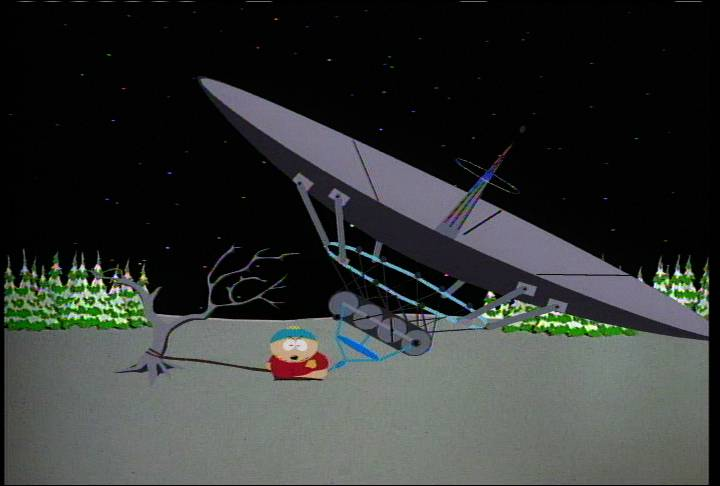
“Cartman Gets an Anal Probe” is the official title of the pilot episode of South Park (Season 1, Episode 1)
A fascinating shift has occurred in modern culture: the belief in extraterrestrial visitation has transitioned from fringe folklore into a mainstream, secular dogma. Proponents of this modern mythology confidently argue that advanced civilizations have been operating on Earth since the mid-20th century, executing a flawless, decades-long game of hide-and-seek right under our noses.
However, when we move past the romanticized narratives of science fiction and subject these claims to a rigorous cross-examination, the debate shifts from a question of “conspiracy” to a question of fundamental physics. The narrative of alien visitation does not fail because of a lack of imagination; it fails under the crushing weight of universal engineering constraints and entropy.
The Ultimate Cosmic Joke: 25,000 Years Just to Play Hide-and-Seek?
Before we even dissect the rigorous math and physics, we have to look at the sheer psychological absurdity of the alien narrative. Think about the absolute comedy of this scenario: an ultra-advanced alien civilization spends 250 centuries crossing the brutal freezing void of deep space. They endure cosmic radiation, generation-ship isolation, and resource scarcity for 25,000 light-years just to reach Earth.
And what is their grand, ultimate mission when they finally touch down? According to believers, they immediately decided to play a massive, decades-long game of hide-and-seek with humanity. Instead of introducing themselves or conquering the planet, they supposedly panicked and ran away to hide in the deep sea right next to SpongeBob, or buried themselves in the freezing ice of the South Pole along with Kal El (Superman). To believe that a species possessing god-like interstellar technology would travel trillions of kilometers just to hide in our oceans with Sponge Bob like a bunch of frightened teenagers is a massive logical insult.
What an idiot!

The Mathematical Illusion of Infinite Possibility
Moving past the hilarious irony of their behavior, the primary intellectual defense for the alien narrative relies heavily on basic probability. The core argument is familiar: “The universe contains trillions of planets; therefore, it is statistically inevitable that an advanced civilization has built the means to reach us.”
While statistically appealing, this perspective suffers from a severe conceptual blind spot. A high quantity of planetary bodies does not automatically guarantee the thermodynamic viability of interstellar transit. Cultivating a planetary system to the point of producing an advanced technological civilization requires a massive chain of chaotic, highly precise variables over billions of years—a framework described by the Rare Earth Hypothesis.
More critically, abstract mathematical probability cannot bend the local physical metrics of our universe. Believers speak of interstellar arrivals as if cosmic distances are merely temporary inconveniences, completely disregarding the scale of our actual galactic neighborhood:
- The Local Baseline: Even our absolute closest galactic neighbor outside the Milky Way, the Canis Major Dwarf Galaxy, is isolated by a gulf of roughly 25,000 light-years.
- The Universal Speed Limit: A single light-year represents a fixed distance of approximately 9.5 trillion kilometers ($9,500,000,000,000 km).
To bridge this specific gap, a physical object must travel at the cosmic speed limit for 250 centuries, (25,000 years). To assert that a civilization simply “arrived in 1950” is to treat the absolute constant of the speed of light as a negotiable variable.
The Tyranny of the Generation Ship: An Entropy Problem
If the physics of space travel doesn’t stop them, the absolute nightmare of logistics certainly will. To bypass the multi-millennium transit time, speculative arguments often invoke highly advanced spacecraft. Yet, when we apply strict logistical realism to a 25,000-year voyage, we are forced to confront the absolute laws of thermodynamics and conservation of mass.
Because biological entities are subject to decay, a journey of this duration fundamentally demands a “Generation Ship”—a massive, closed-loop flying ecosystem where generations must live, reproduce, and die in deep space. This scenario introduces physical constraints that no level of hypothetical technology can completely evade:
- The Resource Pack-Out: To sustain a breeding population across 250 centuries, the initial mass of required consumables (food, water, and fuel) would be monumentally prohibitive.
- The Mass-Energy Kinetic Dilemma: According to relativistic mechanics, accelerating a vessel of such planetary-scale mass to a meaningful fraction of the speed of light requires an exponential, near-infinite amount of energy ($E = mc^2$). A ship massive enough to sustain life for millennia becomes too heavy to efficiently move, creating a critical paradox of propulsion.
- Material Fatigue and Kinetic Interstellar Impact: At relativistic speeds, striking even a microscopic grain of interstellar dust or a stray hydrogen atom carries the kinetic energy of a high-explosive detonation. No known atomic structure or composite material could endure millions of these high-velocity impacts over a 25,000-year period without experiencing catastrophic material fatigue and structural dissolution.
The Teleportation Paradox and Information Entropy
When the material constraints of physical space travel are exposed as a logistical dead end, proponents frequently retreat to the conceptual safety of instantaneous teleportation. They look to quantum entanglement transport or science fiction tropes, treating Star Trek like a documentary.
However, translating teleportation from science fiction into physical reality violates the core principles of information theory and biology. Teleportation requires the absolute deconstruction of physical matter into data or energy, transmission across space, and perfect reassembly at the destination.
This mechanism introduces two fatal flaws:
- The Infrastructure Paradox: Quantum or particle transmission cannot occur in a vacuum without a pre-existing destination matrix. You cannot “teleport” to Earth unless a receiving terminal or cosmic infrastructure was already constructed on Earth prior to your arrival.
- Biological Dissolution: From a thermodynamic perspective, breaking down the complex, highly ordered quantum states of a living, conscious biological organism into raw energy, and transmitting that data across thousands of light-years, subjects the information to cosmic background noise and quantum decoherence. The resulting signal degradation ensures that reassembly would result in absolute biological death—transforming a conscious organism into a disorganized arrangement of organic matter.
Conclusion: The Security of Cosmic Law
Ultimately, the widespread conviction that extraterrestrial visitors are navigating our skies or hiding in our oceans is a secular mythology. It is born not from empirical observation, but from a psychological desensitization driven by decades of cinematic fiction, paired with an existential discomfort regarding humanity’s isolation in the cosmos.
When the romance of science fiction is stripped away, we find that the universe does not rely on government conspiracies to keep its civilizations isolated. The barriers between worlds are absolute, enforced not by classified security clearances, but by the non-negotiable laws of physics, logistics, and cosmic scale.