Before reading, enjoy my Spotify Songs 2026 New Music New Song
When we read the Old Testament today, it is easy to assume it was written as one continuous, harmonious narrative. But if you look closely under the surface, you find what historians call textual “seams”—structural joints where different oral traditions, regional perspectives, and deep political rivalries were compiled by ancient editors.
According to modern biblical criticism, particularly the Documentary Hypothesis pioneered by early scholars like Julius Wellhausen and later developed by researchers such as Richard Elliott Friedman, the Pentateuch is best understood not as a singular monolithic draft, but as a stratification of multiple source texts compiled over centuries. While contemporary biblical scholarship is highly fragmented—with various camps moving away from rigid source partition models toward Supplementary Hypotheses and Neo-Documentarian frameworks that view the text as a far more fluid, non-linear editorial development—there remains a broad consensus that the text preserves distinct layers of composition reflecting different historical eras and geographic origins.
By examining these hidden literary seams, we can observe how the ancient regional division of Israel may preserve traces of competing regional traditions that later editors incorporated into evolving textual strata, how these dynamics influenced the narrative context of Jesus’s ministry, and how the 7th-century Quranic text interprets these textual developments through a theological framework that emphasizes human editorial intervention.
1. The Broken Kingdom: North vs. South
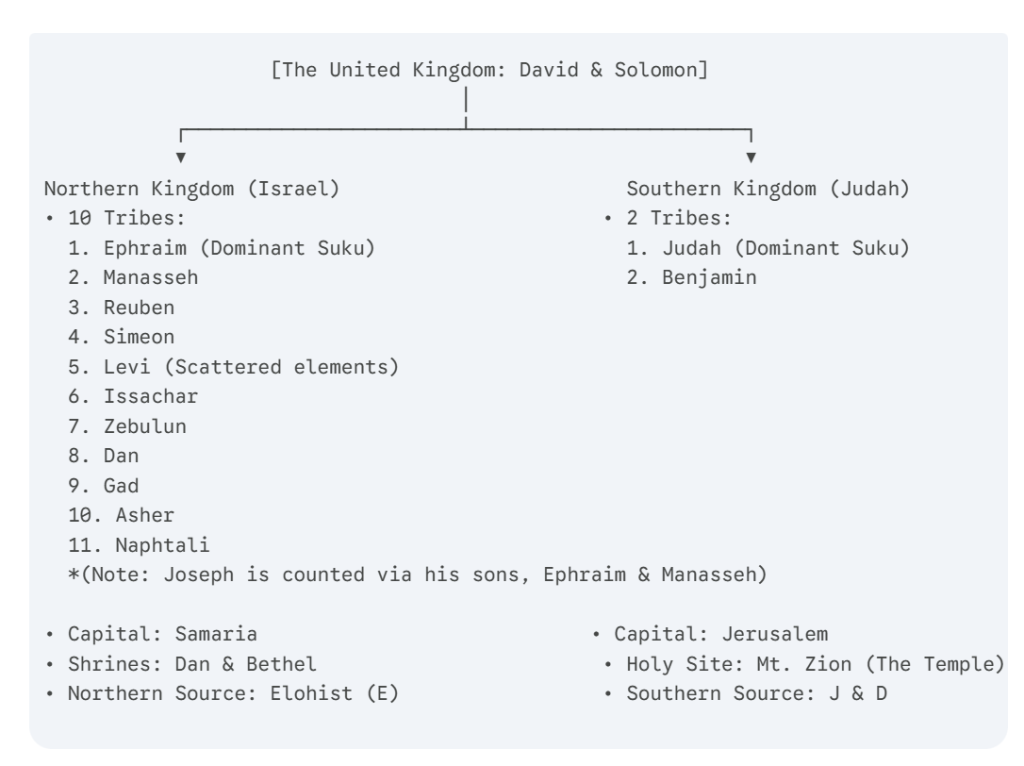
To analyze the regional perspectives embedded in the biblical text, historians frequently look to the historical pivot point following the death of King Solomon (around 930 BCE). The unified monarchy fractured into two competitive geopolitical entities, each establishing its own administrative, political, and religious infrastructure:
- The Northern Kingdom (Israel / Samaria): Comprising 10 of the twelve tribes, this faksi rejected the dynastic monopoly of the House of David and the heavy taxation of Solomon’s successor. Suku Efraim acted as the primary driver in the North, elevating Joseph (father of Efraim and Manasseh) as their cultural patriarch. To secure religious independence from Jerusalem, King Jeroboam I established alternative national sanctuaries at Dan and Bethel. In classical documentary scholarship, this northern textual tradition is primarily associated with the Elohist (E) source.
- The Southern Kingdom (Judah / Jerusalem): Comprising 2 tribes (Judah and Benjamin), this faction maintained control of the capital, Jerusalem, the central Temple, and the surrounding southern military strongholds. This region championed the Davidic covenant and the exclusive legitimacy of Zion. The southern textual tradition is primarily associated with the Yahwist (J) and Deuteronomistic (D) sources.
Because both kingdoms shared a single ancestral lineage, the struggle for theological legitimacy left visible markers not only on fields of battle, but within parallel scribal scriptoriums.
                      [The United Kingdom: David & Solomon]
                                      │
              ┌───────────────────────┴───────────────────────┐
              ▼                                               ▼
   Northern Kingdom (Israel)                        Southern Kingdom (Judah)
   • 10 Tribes:                                   • 2 Tribes:
     1. Ephraim (Dominant Suku)                     1. Judah (Dominant Suku)
     2. Manasseh                                    2. Benjamin
     3. Reuben
     4. Simeon
     5. Levi (Scattered elements)
     6. Issachar
     7. Zebulun
     8. Dan
     9. Gad
     10. Asher
     11. Naphtali
     *(Note: Joseph is counted via his sons, Ephraim & Manasseh)

   • Capital: Samaria                            • Capital: Jerusalem
   • Shrines: Dan & Bethel                        • Holy Site: Mt. Zion (The Temple)
   • Northern Source: Elohist (E)                 • Southern Source: J & D
2. Textual Stratification: Regional Emphases in Ancestral Narratives
In his work Who Wrote the Bible?, Richard Elliott Friedman notes that variations, doublets, and structural anomalies within the Genesis accounts frequently correlate with the geopolitical interests of the northern and southern writer groups. Rather than reconstructing psychological motives too confidently or assuming an intentional, centralized fraud, modern textual critics tend to analyze these anomalies as the gradual preservation of distinct regional memories. Over time, later compilers (such as Aaronid or Deuteronomistic editors) attempted to harmonize these competing traditions into a single, unified canon.
While mapping precise source boundaries remains heavily disputed among specialists—with many passages displaying complex layering that likely predates the monarchy entirely—differing theological and regional emphases still appear to reflect distinct political alignments when the text is examined closely.
Textual Elements Aligning with Northern (Elohist) Traditions
Northern traditions often place significant structural emphasis on the legacy of Joseph (ancestor of the dominant northern tribes, Ephraim and Manasseh) while preserving parallel accounts that highlight severe moral lapses or failures in leadership among southern tribal patriarchs:
- Judah (the patriarch of the Southern Kingdom) fails in his familial duties and engages with his daughter-in-law, whom he mistakes for a prostitute:Genesis 38:15-16 — “When Judah saw her, he thought she was a prostitute… He turned aside to her by the wayside and said, ‘Come, let me come in to you’…”
- Reuben (the oldest brother, whose traditional leadership role was textually superseded by the rise of Joseph in northern accounts) commits a grave domestic violation:Genesis 35:22 — “While Israel lived in that land, Reuben went and lay with Bilhah his father’s concubine, and Israel heard of it.”
- David (the foundational king of the Southern dynastic lineage) commits adultery and orchestrates a wartime execution to cover his tracks:2 Samuel 11:4 — “So David sent messengers and took her, and she came to him, and he lay with her… [Then] David wrote a letter to Joab… ‘Set Uriah in the forefront of the hardest fighting… that he may be struck down, and die.’”
Textual Elements Aligning with Southern (Yahwist/Deuteronomistic) Responses
Conversely, traditions preserved by southern redactors appear to reflect parallel narratives that target the golden calf shrines of Dan and Bethel, or cast peripheral, northern-aligned ancestral figures in a deeply compromised light:
- Aaron (whose lineage was claimed by the priesthood overseeing northern shrines like Bethel) capitulates to the crowd and constructs a golden calf idol:Exodus 32:4 — “And he received the gold from their hand and fashioned it with a graving tool and made a golden calf. And they said, ‘These are your gods, O Israel…’”
- Lot (the primordial ancestor of Moab and Ammon, trans-Jordanian regions closely tied to northern border conflicts) succumbs to intoxication and incest:Genesis 19:33 — “That night they made their father drink wine, and the firstborn went in and lay with her father…”
- Noah (the universal post-flood patriarch) is depicted in a state of severe intoxication and vulnerability within his tent:Genesis 9:21 — “He drank of the wine and became drunk and lay uncovered in his tent.”
3. A Critical Question Regarding Southern Polemics
Why did the Northern Kingdom target specific individuals (Judah, Reuben, David), while the Southern Kingdom focused its critiques on universal or institutional figures like Noah, Lot, and Aaron? Why didn’t the Southern Kingdom attack the Northern tribes of Ephraim or Manasseh directly?
In modern historical-critical analysis, the Southern strategy appears significantly more systematic. Rather than engaging in personal character assassination against specific northern tribal patriarchs, Southern textual traditions targeted the core religious institutions and geopolitical legitimacy of the North.
Below is an exploration of why the Southern (Yahwist/Deuteronomistic) traditions likely preserved these specific narratives involving Aaron, Lot, and Noah:
a. The Enigma of Aaron: The Battle for Priestly Legitimacy
Genealogically, Aaron belongs to the tribe of Levi, a group distributed across both kingdoms. However, following the Great Schism, a fierce conflict emerged over which priestly lineage held exclusive legitimate authority:
- Upon secession, King Jeroboam I of the Northern Kingdom expelled the Zadokite priests who remained loyal to the Davidic throne in Jerusalem (South).
- In their place, Jeroboam I appointed an alternative priesthood at the national sanctuaries of Dan and Bethel. These Northern priests claimed their legitimacy through the lineage of Aaron (the Aaronid priesthood).
- This connection is highlighted when Jeroboam dedicates the golden calves at Bethel using phrasing identical to that found in the wilderness narrative (1 Kings 12:28).
- The Southern Textual Strategy: Southern scribes did not target the Northern tribes genetically. Instead, they focused on the root legitimacy of the Northern priesthood. Through the narrative of Exodus 32, the Southern tradition implicitly argues: “You in the North take pride in the Aaronid priesthood of Bethel? Remember that Aaron, the very source of your priestly lineage, was the first to construct the golden calf that brought judgment upon the nation.”
b. The Critique of Lot: Geopolitics of the Transjordan
The Southern Kingdom did not need to delegitimize the Northern tribes genealogically, as they still viewed them as estranged brothers within the covenant. However, the North maintained close geopolitical, economic, and military ties with kingdoms east of the Jordan River (the Transjordan), specifically Moab and Ammon.
- In the ancient geopolitical landscape, the Northern Kingdom frequently controlled, allied with, or contested border territories alongside the nations of Moab and Ammon.
- The Southern Textual Strategy: The narrative of Lot in Genesis 19 functions as a highly targeted geopolitical critique. At the conclusion of the account (Genesis 19:37-38), the text explicitly names the children born of Lot’s incestuous encounter with his daughters as the primordial ancestors of Moab and Ammon.
- By preserving this account, Southern textual traditions cast a long shadow over the regional allies of the North, suggesting that these neighboring nations originated from an act of severe intoxication and domestic violation.
c. The Vulnerability of Noah: The Curse of Canaan
Why would a universal heroic figure like Noah be depicted in a state of severe intoxication and vulnerability within a tradition heavily shaped by Southern compilation? The answer appears to lie in the recipient of the resulting curse.
- When Noah succumbs to wine, his son Ham discovers his vulnerability. However, upon awakening, Noah does not pronounce a curse upon Ham; instead, he explicitly curses Ham’s son, Canaan.
- Genesis 9:25 — “He said, ‘Cursed be Canaan; a servant of servants shall he be to his brothers.’”
- The Southern Textual Strategy: The territory of the Northern Kingdom (encompassing Samaria, Shechem, and Bethel) formed the geographic heartland of ancient Canaan. Historically, Northern populations coexisted alongside remaining Canaanite enclaves and frequently integrated agrarian fertility rituals (such as the veneration of Baal and Asherah) into their religious landscape.
- By maintaining the narrative of Noah’s curse upon Canaan, Southern redactors provided a theological explanation for why the Northern territory was viewed as inherently prone to idolatry: the very land inhabited by the North was structurally linked to the ancient curse of Canaan from the dawn of post-flood civilization.
4. The Paradox of Jesus: A Southern Lineage Recommencing in the North
This deep-seated socio-cultural split between Judea (the South) and Galilee/Samaria (the North) persisted long after the political collapse of both kingdoms, carrying major historical implications into the first century CE.
By prophetic and genealogical parameters, Jesus of Nazareth was anchored entirely to the Southern Kingdom’s messianic expectations. He belonged to the tribe of Judah, descended directly from the Davidic line, and was born in Bethlehem—the geographic center of southern royal claims.
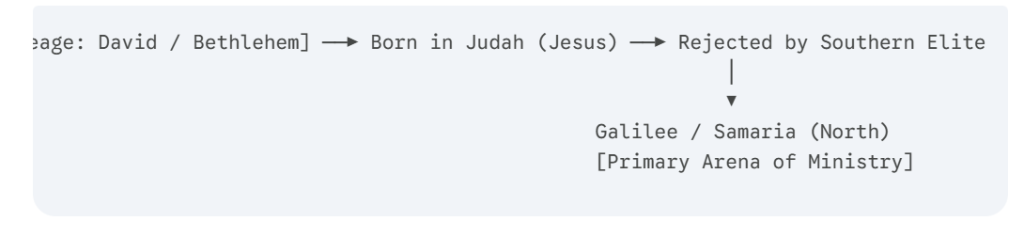
[Southern Lineage: David / Bethlehem] ──► Born in Judah (Jesus) ──► Rejected by Southern Elite
                                                                        │
                                                                        ▼
                                                             Galilee / Samaria (North)
                                                             [Primary Arena of Ministry]
Yet, the primary historical reception of his ministry, as recorded in the Gospels, reveals a distinct geographic paradox. The facial hostility or skepticism he encountered from established religious and political authorities in Jerusalem (“Can anything good come out of Nazareth?”) highlighted the enduring cultural divide. Consequently, the Gospel traditions place the vast majority of his public ministry, his primary discourses, and his earliest community formation within the northern territories of Galilee and Samaria, rather than the southern institutional center.
5. The 7th-Century Audit: How the Quran Addresses Textual Alterations
In the early 7th century CE, the Quran emerged in the Hijaz region of Arabia. Positioned within Islamic theology as both Furqan (the criterion for distinguishing truth from falsehood) and Muhaimin (a guardian and external auditor over preceding scriptures), the Quran addresses the historical reality of scribal interventions.
From a strictly historiographical perspective, the Quran operates as a later, confessional document presenting its own theological evaluation of history rather than a neutral, secular critique. Within that religious framework, however, the Quranic text provides an explicit critique of the specific editorial mechanisms attributed to ancient priestly classes and scribes (Ahbar and Ruhban), analyzing them as adjustments designed to serve localized socio-political or material ends.
Exposing Manual Textual Additions (Tahrif al-Kitabah)
The Quran identifies the process of manual textual interpolation—interpreting human commentary or regional polemics as being transcribed directly into manuscripts and presented as absolute divine law—in Surah Al-Baqarah (2:79):
$$\text{فَوَيْلٌ لِّلَّذِينَ يَكْتُبُونَ الْكِتٰبَ بِأَيْدِيهِمْ ثُمَّ يَقُولُونَ هٰذَا مِنْ عِندِ اللَّهِ لِيَشْتَرُوا بِهِ ثَمَنًا قَلِيلًا}$$
“So woe to those who write the scripture with their own hands and then say, ‘This is from Allah,’ in order to exchange it for a small price…”
Addressing the Dislocation of Textual Context (Tahrif al-Ma’ni)
The specific editorial technique of lifting narratives out of their original historical or moral contexts—realigned by compilers to serve later polemical agendas—is explicitly described in Surah Al-Ma’idah (5:13):
$$\text{يُحَرِّفُونَ الْكَلِمَ عَن مَّوَاضِعِهِ}$$
“…They distort words from their proper places and have forgotten a portion of that of which they were reminded…”
Pinpointing the Material and Institutional Motives
The Quran attributes these scribal shifts directly to institutional self-preservation, political leverage, and economic control in Surah At-Tawbah (9:34):
$$\text{إِنَّ كَثِيرًا مِّنَ الْأَحْبَارِ وَالرُّهْبَانِ لَيَأْكُلُونَ أَمْوٰلَ النَّاسِ بِالْبٰطِلِ}$$
“…Indeed, many of the scholars and monks devour the wealth of people unjustly and turn them away from the way of Allah…”
6. The Modern Blind Spot: Misunderstanding the Grudge
A profound irony exists within modern mainstream Christian theology regarding these passages. Today, millions of readers approach these highly specific, scandalous narratives—such as the moral lapses of Judah, Reuben, or Lot—through a purely devotional or homiletical framework, completely unaware of the underlying historical and regional friction.
Without the context of the Northern vs. Southern scribal tension, modern commentators often normalize these passages as intentional examples of “moral realism” or “covenantal fallenness.” The standard theological explanation shifts to: “These stories are preserved simply to show that even great biblical figures were flawed, broken sinners in need of grace.”
Historically, this devotional reading significantly influenced the development of Western hamartiology (the doctrine of sin) and soteriology (the doctrine of salvation). By treating regional polemical entries as absolute reflections of universal human depravity, Christian systematic theology reinforced a narrative landscape that complemented the development of substitutionary atonement models.
While historical-critical scholarship identifies alternative roots for Christian atonement theology—including Second Temple Jewish sacrificial models, Pauline theology, and Greco-Roman apocalyptic traditions—the reading of Old Testament heroes as universally compromised provided a stark narrative contrast that deeply integrated with the theological necessity of the cross in the Western church.
Conclusion
Isolating these textual layers, regional biases, and compilation seams within the Old Testament does not reduce its value; rather, it highlights the deeply complex human history behind its transmission. The textual seams map out an ancient literature that weathered foreign exile, shifting geopolitical borders, and internal civil conflict.
While many aspects of the text’s development remain heavily debated, the preservation of layered regional traditions remains a major feature of historical-critical analysis. When viewed as an integrated historical arc, the regional friction between Israel and Judah left alternating editorial marks across the Genesis and Deuteronomistic histories. Centuries later, the early Christian movement inherited these compiled manuscripts, interpreting the systemic flaws of old covenant figures as a universal prelude to the mission of Jesus.
Finally, from an Islamic theological standpoint, the 7th-century Quranic discourse approached the canon as an external, corrective authority—declining to validate either the northern Samarian or southern Judean regional biases, interpreting these textual developments through a theological framework that emphasizes human editorial intervention, and systematically working to restore the moral integrity of the prophetic figures who had been caught in the crossfire of an ancient civil war.