Writer: Ghailan, IRGH
1. The Horror of Ken Arok: Why Javanese Elites Feared Street-Level Coups
To understand why a state would feel the need to invent a “ghost” ruling the deep ocean, we have to look at just how fragile a human ruler’s physical hold on power really is. In the year 1222, a regular man from East Java—a bandit, commoner, and laborer named Ken Arok (1182–1227)—completely shattered the illusion that kings were untouchable, divine beings. Armed with a cursed keris dagger and cold, bloody ambition, he murdered Tunggul Ametung, the ruler of Tumapel. Ken Arok didn’t just seize the throne to rule as Sri Rajasa Bhatara Sang Amurwabhumi; he also claimed the former king’s exceptionally beautiful wife, Ken Dedes.
In the reality of 13th-century Java, this was power stripped bare. Authority was highly visual, instant, and completely unprotected by institutional camouflage. Ken Arok’s successful coup sent a terrifying message to the Javanese aristocracy: if a street bandit could make a king bleed, then any peasant could destroy a dynasty. For the royal families born after this era, this piece of history was the ultimate nightmare—a fatal flaw in their armor that could never be allowed to happen again.
2. Nyi Roro Kidul: Moving the Threat to the Ocean (1586)
When Panembahan Senopati founded the Islamic Mataram Sultanate in 1586, this vulnerable old blueprint of power was completely dismantled. The palace realized that thick fortress walls and regular troops would never be enough to stop the next “Ken Arok.” They needed a smarter strategy, so they turned to political mysticism. The state gradually adopted a brilliant psychological rule: the masses fear nothing more than what they cannot see.
This marked the beginning of the Nyi Roro Kidul narrative, which was heavily pushed by palace propaganda. I previously broke down the psychological blueprint behind this exact tactic in my book, “Salah Paham tentang Setan, Jin, Roh, Hantu, dan Sihir” (published in March 2004, over 20 years ago!). The book explains how sensory illusions, strange natural shifts in electromagnetic fields, and state-backed mysticism have been weaponized throughout history to control, guide, and dictate the behavior of large crowds.
In the context of Mataram, a very specific doctrine was injected into the public mind: that the sovereign ruler was no mere mortal politician, but spiritually bound in a holy marriage to the terrifying, supernatural Queen of the Indian Ocean.
Suddenly, the wild currents, violent waves, and eerie atmosphere of the Southern Sea became the state’s ultimate cosmic law enforcer. The legendary Indonesian author Pramoedya Ananta Toer, along with early Dutch historical observers, noted how Western administrators were completely baffled by how easily Javanese kings maintained absolute control over such massive lands. They didn’t need a giant, expensive standing army or an aggressive police state in every village.
The fear was entirely self-enforced. Public rebellion became a spiritual impossibility. Trying to overthrow the King was no longer about fighting a mortal man; it meant declaring war on a supernatural deity ruling the deep sea.
To cement this social divide permanently, satirical plays like Petruk Dadi Ratu (Petruk Becomes King) were deliberately woven into traditional Wayang Kulit (shadow puppetry). The message to the common folk was blunt and mocking: You are just a punakawan clown, a mere peasant. You don’t possess the royal spiritual bloodline. Don’t even dream of touching the crown.
Because domestic stability was safely “guarded” by this engineered psychological fear, the Javanese elites grew comfortable. This state of mind likely contributed, at least indirectly, to the neglect of their external defenses. They saw little need to spend heavily on modernizing their large-scale military doctrines or keeping up with modern weapon technologies that were becoming faster, stronger, and far more lethal. Consequently, their massive agricultural wealth wasn’t reinvested into a flexible defense industry. Instead, it sat passively in underground bullion vaults beneath the palace—acting as a massive jackpot waiting to be harvested by foreign powers with superior military technology.
3. The Gold Vault of Southeast Asia (The Multicurrency Era & Financial Intelligence Leak)
The byproduct of this mystical-political stability was an absolute economic boom for Mataram throughout the 17th and 18th centuries (1600–1700). Without major civil wars tearing up the heart of the kingdom, Mataram grew into an export powerhouse in Southeast Asia.
Millions of tons of rice flowed from Java’s fertile fields to supply port cities across the archipelago, effectively serving as a pillar of food security along Asian maritime trade routes. High-quality teak wood from Javanese forests was harvested and exported to become the primary raw material for international shipyards, stretching from India to East Asia. On top of that, Mataram became a dominant producer of sugarcane and secondary spices highly sought after by global merchants, penetrating major markets from Western India all the way into Imperial China.
For the generation born in the 1960s and 1970s who grew up reading the classic Donald Duck comics, you probably remember how Scrooge McDuck treated his wealth. He had his Money Bin—a massive storage building (bullion vault) filled with towering mountains of cash and pure gold. Scrooge didn’t even sleep on a mattress; he would dive, swim, and sleep directly on top of his accumulated precious metals.
This fantastic visual is actually a pretty accurate reflection of the Javanese Sultan’s treasure vaults, which held wealth worth trillions of rupiah in today’s money. Since modern banking institutions didn’t exist back then, the state’s financial management was handled directly by the palace through a highly advanced international multicurrency network:
- Chinese Kepeng (Cash) Coins: Used for daily transactions in local markets by ordinary citizens.
- Spanish Silver Reals (Pieces of Eight): The “US Dollar” of the ancient world, used as the global standard for international trade and large tax payments.
- Global & Regional Gold: Islamic Gold Dinars and pure gold bullion that flowed directly into the pockets of the aristocracy.
Psychologically, Javanese rulers had a very specific safety preference. They trusted concentrating and locking up all this liquid wealth in a single spot—an underground treasure vault inside the central palace complex—rather than scattering it across isolated mountains or coastal areas near the sea.
However, this created a massive blind spot in their national defense. This massive mountain of liquidity sitting in one location was easily picked up by Western intelligence. Stamford Raffles did not arrive in Java guessing blindly. Based on the political mapping of the time, there are strong indications that through a systematic espionage network, Raffles successfully mapped out an accurate estimate of the gold reserves held by Javanese and Sumatran kings.
This leaked financial data reached British hands through a combination of local informants, interrogations of former VOC officers who knew the tribute routes, reports from merchant middlemen, and tips from the kings’ political rivals seeking British protection. The palace might have felt secure behind the myth of Nyi Roro Kidul, but they had no idea their underground “safe” had already become a calculated variable in British military strategy long before the actual operation began.
4. The British Storm Destroys the Franco-Dutch Hegemony
The global geopolitical landscape shifted drastically heading into the 19th century. The Industrial Revolution in Europe gave rise to a new type of global powerhouse: a highly efficient, modern, and lethal British Empire. By the time Thomas Stamford Raffles arrived in the archipelago, British military superiority was on an entirely different level.
In just a matter of days, Raffles shattered the dominant Franco-Dutch forces led by Governor-General Jan Willem Janssens. Directed by iron-fisted tactical generals, British troops swept through the defenses of Batavia (Jakarta) in a few days before moving quickly to capture the Bogor Palace without facing any meaningful resistance. The colonial troops, who had long terrified the local population, suddenly looked confused and disorganized—like amateurs—in the face of disciplined British infantry.
5. Mataram’s Pride Meets Modern Military Strategy
Seeing how quickly the colonial defenses collapsed, several local rulers immediately took realistic steps. Sultan Mahmud Badaruddin II of Palembang cleverly chose a scorched-earth strategy, burning his own palace before escaping deep into the jungles to launch a long guerrilla war. The British troops arrived only to find an empty, blackened capital. Meanwhile, Sunan Surakarta, recognizing the reality of the situation, opted for pragmatic diplomacy and surrendered immediately to save his dynasty from total destruction.
However, Yogyakarta—the primary heir to the Mataram lineage—chose a stubborn path of resistance. Blinded by the myths of past glory, the assumed psychological protection of the Southern Sea, and a traditional army numbering in the tens of thousands, they felt confident they could stop the British Empire.
Armed conflict was inevitable, and the result was brutal. Within just hours of British artillery breaching the earthen walls, Mataram’s legendary defenses collapsed. Traditional weapons and ancient battlefield tactics were simply no match for a modern, industrial siege train.
6. The Tragedy of Geger Sepehi: A Two-Trillion-Rupiah Sacking
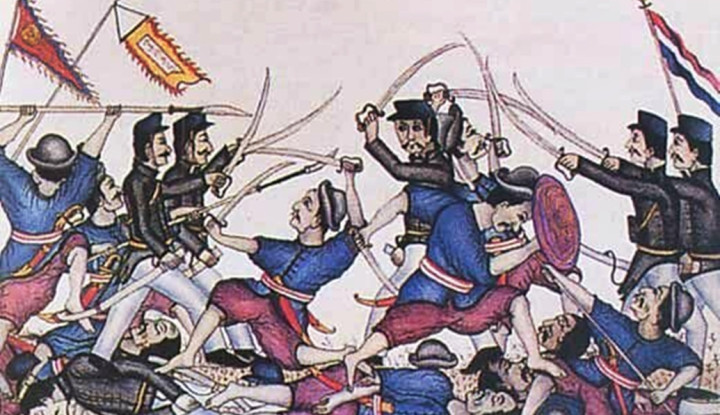
This tragic downfall was written in blood and tears into Javanese history as the Geger Sepehi (The Sack of Yogyakarta). The event, which took place on June 19–20, 1812, was far from a standard political takeover. It was a calculated act of economic decimation and structural cultural purging, executed coldly and systematically.
In a lightning assault, British forces under Letnan Governor Thomas Stamford Raffles and Colonel Robert Rollo Gillespie breached the walls and brutally sacked the Yogyakarta Kraton, the primary successor state of the Mataram Empire.
The British systematically stripped the palace of its sovereign treasure:
- Gold Bullion: British troops dug out roughly 350 kilograms of pure gold from secret underground rooms.
- Global Currency: Around 800,000 Spanish silver dollars were seized as spoils of war.
- Corporate Prize Money: The looting was so unrestrained that Colonel Gillespie personally pocketed 74,000 silver dollars as his private “prize money,” completely separate from the official cut given to field officers.
When calculated using modern commodity valuation methods, the liquid precious metals stolen from the heart of Java were worth a staggering amount: over $55 Million USD, or nearly IDR 2 Trillion.
Ironically, this trillion-rupiah figure only accounts for the raw weight value of the gold and silver. This massive loss doesn’t even begin to cover the destruction of the kingdom’s intellectual assets. Thousands of ancient manuscripts, historical chronicles, royal libraries, sacred regalia, and jewel-encrusted family heirlooms were packed into wooden crates, loaded onto British ships, and carried away across the ocean. The royal treasury was emptied out in a matter of days, leaving Mataram financially bankrupt and culturally crippled.
7. The Parade of Humiliation: A Ruler Without a Crown
The humiliation of the Mataram dynasty peaked on the afternoon following the collapse of the palace walls. Sri Sultan Hamengkubuwono II (Sultan Sepuh) had to face the bitter reality of being dragged out of the Kraton gates by British soldiers.
For the Javanese community at the time, this sight completely shattered their understanding of the world and tore apart the divine dignity of their ruler. For years, the Sultan was viewed as a holy figure, the sacred axis of the universe. He was the most revered human alive; whenever he walked, ministers, patihan, princes, and commoners alike had to drop to their knees, bow their heads to the dirt, and never dare look directly at his face to preserve his sacred aura.
Yet on that afternoon, centuries of sacred protocol evaporated at the tip of a bayonet. The Sultan was forced to march on foot under a scorching sun toward temporary detention in Semarang, before ultimately being sent into exile to Ceylon (Sri Lanka).
There were no golden royal carriages left. No court attendants carrying the grand state umbrellas. The King—usually worshipped like a living god on his throne—was now walking without his royal shoes or sandals, stripped of the gold chains of state majesty, and without a crown on his head. Wearing only a rumpled, ordinary cloth robe, he walked haltingly through the street dust, heavily guarded by a line of foreign soldiers in bright red coats (Redcoats).
Along the outer courtyards of the palace and all the way down the road to Semarang, this parade of humiliation was surrounded by weeping onlookers. Surviving ministers, pangeran, loyal abdi dalem courtiers, and devoted commoners lined the streets, prostrating themselves helplessly on the ground. Even though their leader had been stripped of every physical symbol of power, their inner loyalty remained unbroken. They watched this taboo scene through heavy, historic tears, mourning the instant collapse of Javanese sovereignty. For these loyal servants and subjects, the destruction of the physical palace and the arrest of the Sultan was not just a lost battle—it was a cosmic apocalypse where the very center of their sacred universe had been trampled under the boots of a foreign army.
This was the worst day for the Javanese people.
An experiment in governance built on mystical illusions and the passive hoarding of wealth over two centuries fell apart in a few hours. A king who just the day before stood at the absolute peak of a divine hierarchy was evacuated as a prisoner of war who had lost everything. It left behind a very expensive historical lesson: honor, absolute obedience, and domestic worship from your own people can never buy safety from a real, global military assault.
8. The Tragic Negligence of the Javanese Kings
The tragedy of Geger Sepehi serves as a harsh historical autopsy on national risk management. Imagine being the leader of a dynasty sitting on top of an accumulated fortune worth IDR 2 Trillion, yet that massive wealth is kept passively inside a basement underneath your palace courtyard.
The Javanese kingdom fell victim to gross negligence. By placing absolute trust in the “Nyi Roro Kidul” security system—which had successfully kept their own domestic populace compliant for two centuries—the high command likely grew complacent, failing to see that the tactical world outside had changed radically. The core issue wasn’t that Mataram didn’t invest in a military at all, but rather that their investment remained stuck in traditional patterns. They failed to keep up with the modernization of weapons that were becoming far more destructive and efficient. With that level of liquidity, Mataram failed to invest its wealth into building modern educational institutions, funding scientific research, establishing industrial-scale weapon factories, or updating its military doctrines to adapt to the times.
They were too busy preserving old traditions, stacking gold bars, and relying on a psychological defense system based on mysticism to keep their own subjects afraid. When an outside civilization arrived carrying advanced gunpowder technology, sophisticated artillery tactics, and modern conflict management, that trillion-rupiah “bank balance” inside the palace changed roles overnight. It was no longer a guarantee of sovereignty; it became a massive target for foreign plunder. Wealth without modern defense capabilities is simply a jackpot waiting for someone else to claim it.
(the end)
References:
- Hannigan, Tim. (2010). Raffles and the British Invasion of Java. Singapore: Monsoon Books. (Regarding tactical data of British military movements, the collapse of Janssens’ colonial forces, and the financial audit details of the Geger Sepehi plunder).
- Ghailan, IRGH. (2004). Salah Paham tentang Setan, Jin, Roh, Hantu, dan Sihir. Jakarta. (Regarding the psychological-political analysis of sensory engineering behind the Nyi Roro Kidul narrative).