DISCLAIMER NOTICE & ESCAPE CLAUSE
The entire contents of this manuscript are written purely as an objective, scholarly evaluation based on Risk Engineering methodologies, Product Liability analysis, and the theories of causality in positive criminal law. This analysis is independent, technical, and completely free from any subjective bias or political tendency. This text is intended solely for educational purposes, industrial risk modeling, and academic discussion. The author, Ghailan IRGH, is a senior general insurance professional holding an S.Si. academic degree alongside AAAIK, APAI, CIIB, and BNSP Level 7 professional competency certifications.
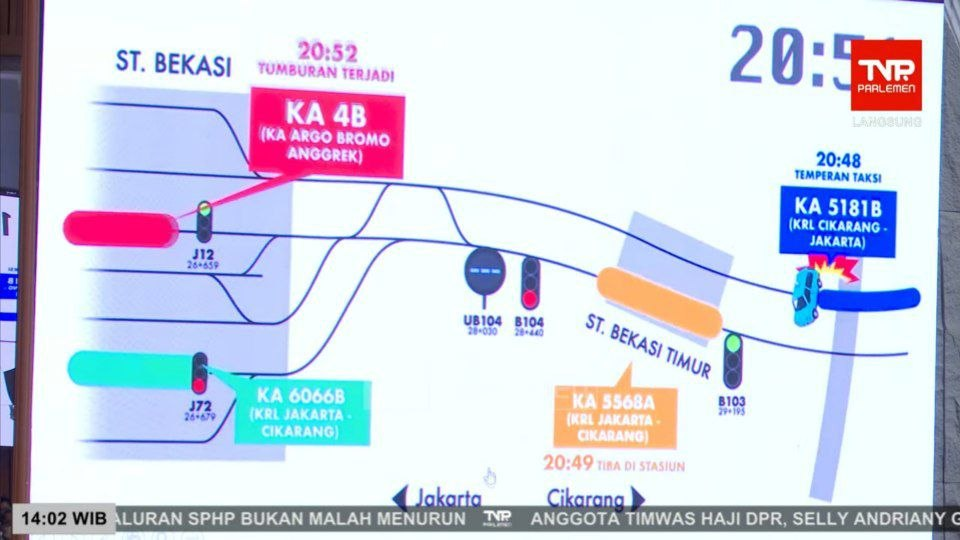
Whenever a fatal incident occurs at a grade crossing involving public transportation, public perception and law enforcement tend to undergo an extreme oversimplification: hunting for a single subject on the ground to bear the entire weight of the blame. This conventional approach relies heavily on the normative legal but-for test—arguing that if the taxi had not stalled, the subsequent chain-reaction disaster would never have occurred.
However, through the lens of Risk Engineering and Root Cause Analysis (RCA), a major industrial-scale disaster rarely stems from a single failure. The fatal accident on the Bekasi line on April 27, 2026, serves as a textbook example of an Accumulated Risk Failure involving three distinct dimensions of accountability: the Human Element, Product Defect, and Systemic Infrastructure Mitigation Failure.
This article objectively dissects how risk exposure must be equitably and fairly distributed among the responsible parties.
1. The Taxi Driver: Testing the Negligence Threshold
In operational risk modeling, the accountability of a legal subject cannot be instantly presumed innocent or guilty without passing a rigorous negligence threshold test regarding the initial incident on the Down-Track at 20:48 WIB. Forensic investigators must test the exact control limits of the driver:
- Testing for Gross Negligence: The investigative team must verify if the taxi driver engaged in active traffic violations, such as deliberately gate-crashing the crossing while the warning sirens were blaring and the barrier arms were descending. If these indicators are met, the driver satisfies the elements of criminal negligence (culpa) under Article 310 of Law No. 22/2009 on Electronic Traffic and Road Transport (UU LLAJ) and must be held fully liable for the first incident—the collision between his taxi and Commuter Line train KRL 5181B.
- Testing for Pure Technical Failure: Conversely, if Event Data Recorder (EDR) telemetry proves that the driver entered the crossing under safe conditions but the vehicle suffered an instantaneous, catastrophic loss of power directly on the tracks, the element of personal negligence is legally nullified. The event shifts into the realm of force majeure (overmacht) pursuant to Article 48 of the Indonesian Criminal Code (KUHP).
a. Spatial Boundaries of Risk Localization
A critical point regarding legal causality must be established: regardless of the negligence test outcome, the driver’s risk exposure remains a localized risk strictly confined to the Down-Track incident at 20:48 WIB.
Even in the worst-case scenario where the driver is proven negligent in the initial collision, his fault cannot be elastically stretched to carry the liability for the subsequent collision between the Argo Bromo Anggrek express train and KRL 5568A on the separate Up-Track minutes later. Legal enforcement against the taxi driver must be rigidly restricted to the boundaries of the initial incident.
2. The Electric Vehicle Manufacturer: The Origin of Emergency Evacuation Failure
If testing proves that the vehicle suffered a sudden power failure absent driver error, the focus of risk accountability automatically jumps to the second dimension: Product Liability of the Electric Vehicle (EV) manufacturer.
In Risk Engineering, mass-transportation products must be engineered under failsafe principles. This dictates that when internal computer systems experience mechanical failure or sudden depletion, auxiliary emergency systems must ensure the vehicle can still be evacuated from a hazard zone. In the Bekasi incident, however, the EV’s computerized architecture triggered a total deadlock and systemic lockdown:
- The Electric Parking Brake (EPB) permanently locked the wheels due to the absence of power.
- The vehicle lacked an easily accessible mechanical emergency bypass lever designed to be operated from outside the cabin.
As a direct consequence of this design defect, the vehicle acted as a static anchor that could not be manually pushed clear by nearby citizens. Scientifically, the manufacturer bears a significant portion of the risk for eliminating the opportunity for emergency evacuation, which served as the catalyst for the subsequent chain of perils.
3. PT KAI: Systemic Management Negligence and Railway Safety Omissions
The third dimension, which ultimately dictated the catastrophic fatality of the final outcome, lies in the operational control systems and protection standards of the railway infrastructure itself. To establish a risk management benchmark, we can examine the maritime and port sectors.
To prevent collisions within narrow channels, congested waters, or berths, the maritime industry deploys layered mitigations—utilizing massive steel hulls, tugboats, pilots, and guiding vessels. Furthermore, physical berth structures are rigidly reinforced with giant energy-absorbing rubber fenders to cushion impacts if navigational mitigations fail.
The critical question is: Why was this rigid structural protection philosophy not optimally implemented within our railway system? Three massive vulnerabilities in PT KAI’s operational risk management collapsed during this incident:
a. Absence of Crashworthiness Standardization (EN 15227)
Modern global railway engineering relies on international crashworthiness standards, most notably EN 15227 (the European standard for crashworthiness requirements on railway vehicle bodies). This technology integrates designated deformation zones (crumple zones) and anti-climber devices onto car ends to absorb massive kinetic energy during a collision, preventing the rolling stock structure from collapsing, telescoping, or crushing passengers—the primary cause of fatalities.
Why has PT KAI failed to integrate these structural safety systems comprehensively? This is particularly egregious for long-distance express fleets like the Argo Bromo Anggrek, whose operational profile dictates high-speed bypasses through small, non-transit stations. The absence of these energy-absorbing shields left the structural damage of the cars completely unmitigated.
b. Systemic Blindness: How Consumer Tech Outpaces Railway Command Systems
Simple consumer-grade technology, such as the concept behind the LIFE 360 application, has proven that real-time coordinate tracking can be accessed instantaneously by anyone. In an industrial railway setting, this type of digital interconnectivity should be a mandatory cockpit integration.
Through real-time dashboard visualizations, train drivers (both in front and behind a hazard) alongside the Operations Control Center (OCC) should instantly see the exact position of every active train whenever a blockage occurs. When the second KRL train was forced to execute an emergency stop due to crowd movement on the Up-Track at 20:49 WIB, the conventional operational control system proved sluggish and incapable of mitigating this vulnerable position in real time.
c. The Fatal Signaling Anomaly on the Up-Track
The most damning indicator of independent management negligence was allowing the Outbound Signal J12 (Sinyal Keluar J12) to display a GREEN aspect to the oncoming Argo Bromo Anggrek for nearly 3 minutes after the track ahead was statically blocked by the second KRL train.
In determining criminal liability for negligence (Articles 359/360 of the KUHP), Indonesian jurisprudence rejects absolute causality theories. The misleading green signal that prompted the driver to maintain an express speed of 108 km/h acts as the active and efficient cause of the fatal collision on the Up-Track, completely severed from the initial taxi incident.
4. The Risk Distribution Hierarchy
Deconstructing this sequence of failures into an objective, industrial risk accountability matrix yields the following distribution of liabilities:
| Accountability Dimension | Failure Classification | Scope of Liability |
| Taxi Driver | Human Element | Strictly localized to the Down-Track incident at 20:48 WIB (Subject to Traffic Negligence Testing). |
| EV Manufacturer | Design Defect | Liable for the structural elimination of the vehicle’s manual emergency evacuation capabilities. |
| PT KAI (Operator) | Systemic & Safety Negligence | Absolute liability for the absence of real-time interconnectivity systems, the lack of EN 15227 crashworthiness standards on high-speed fleets, and the functional failure of the Up-Track signaling protection systems at 20:52 WIB. |
5. The Reality of Power and Risk
From a pure, scientific risk architecture standpoint, the mega-infrastructure operator holds the largest share of accountability for the systemic failure on the Up-Track. However, in corporate realities where risk intersects with institutional power (ruling party men), the law is often less inclined to explore deeper systemics.
This is where the phrase “Saved by the bell” manifests politically: the protective shield of regulatory bodies, bureaucracy, and structural power tends to insulate massive institutions from systemic prosecution.
Summary
The Bekasi railway tragedy of April 27, 2026, proves that dumping the liability for PT KAI’s Up-Track safety management failure onto a taxi driver who suffered a technical breakdown on the Down-Track is a fatal flaw in legal logic.
When time lapses, separate operating tracks, an absence of crashworthiness impact mitigations (EN 15227), and clear systemic signaling failures have severed the old chain of causality, accountability must be equitably distributed. The taxi driver must be legally decoupled from the fatal train-on-train collision, and safety audits must be strictly directed at automotive product defects and the systemic reliability of the national railway protection network.