Separating the Quranic Constitution/Law from the Policy of the 7th-Century President/Leader of Medina
Introduction: Accused of Being “Less Pious” Simply for Rejecting One Hadith
When I rejected the use of hadiths regarding the punishment of stoning (stoning to death for adultery) on the rational grounds that not a single verse in the Quran commands such a punishment, the knee-jerk reaction from my own younger sibling (and perhaps the majority of Muslims) was to label me “Ingkar Sunnah” (Hadith-denier)—which sounds equivalent to being a “Half-Muslim” or “Less Pious.”
This stigma stems from massive historical amnesia. People who absolutely require Hadith as a dogma equal to the Quran often fail to understand the sociological dynamics and governance during the first 50 to 200 years following the death of the Prophet Muhammad (PBUH).
They might assume that books of hadith were compiled, organized, and authenticated from the very first day the Prophet passed away on Monday, June 8, 632 CE. However, historical audit proves otherwise. Not a single compiled volume of hadith was left behind, authorized, or distributed to the Companions.
1. Chronological Audit & Field Reality (25-Year Timeline Scale)
Era 0 – 25 Years Post-Prophet (632 – 657 CE): Era of Constitutional Protection
- Conditions: The first-generation eyewitnesses (senior Companions such as Abu Bakr, Umar, and Uthman) held full control over the state of Medina.
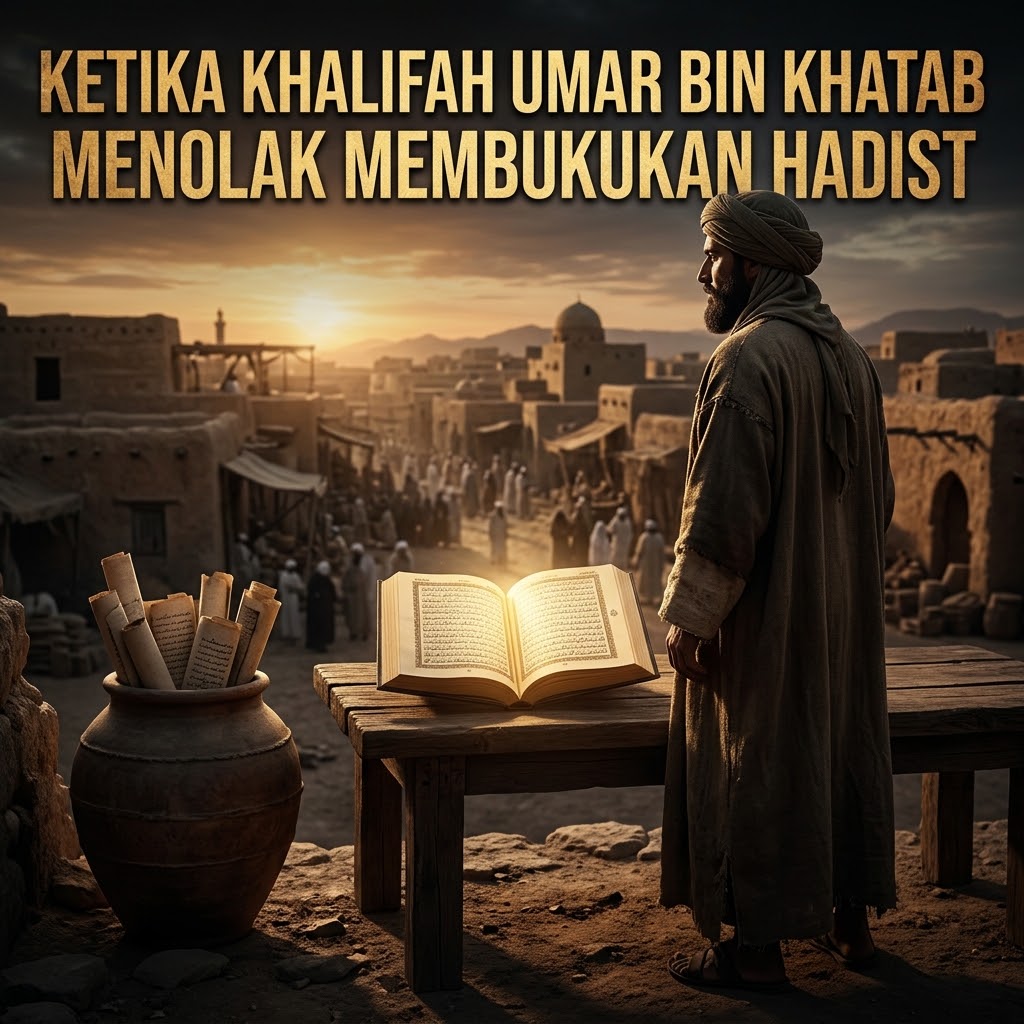
- Executive Action: Umar bin Khattab consciously and firmly refused to compile the hadiths. Umar placed a freeze on the codification of executive notes so that the public would focus exclusively on the Quran as the State’s sole Eternal Constitution.
- Legal Status: Law operated based on the Constitutional Text (the Quran) and Sunnah Amaliyah (mass worship practices observed publicly), rather than on individual oral text transmissions.
Era 25 – 50 Years Post-Prophet (657 – 682 CE): Civil War, Narrative Anarchy, & Systemic Safeguards Break Down
- Conditions: Senior Companions began to pass away due to age and warfare (Battle of the Camel, Battle of Siffin, up to the Karbala Tragedy). The Caliphate transitioned into a Dynastic rule (Umayyad).
- Narrative Anarchy & Oral Transmission: Entering this 50-year mark (around the 680s CE), not a single primary book of hadith (such as Sahih Bukhari or Sahih Muslim) was in circulation. Teaching was predominantly conducted orally (by memory) from mouth to mouth without verification tools.
- Political Fabrications (Fitnah Kubra): Massive political divisions among the Umayyad, Shia, and Kharijite factions triggered widespread creation of narratives to legitimize political claims and eliminate opponents. Certain groups relied on narrative A while others used narrative B, without any central institution to verify authenticity.
Era 50 – 75 Years & Beyond (682 CE – 2nd Century AH): Free Mixing Without Standards (Authentic & Weak Mixed Together)
- Conditions: The generations of the Tabi’un (Successors) and Tabi’ al-Tabi’in (Successors of the Successors) received oral reports secondhand, thirdhand, and fourthhand.
- Unrestricted Mixing in Daily Discourse: Because standardized textual criticism (ilm mustalah al-hadith) or the filtration of Sahih Bukhari did not yet exist, reports that would later be classified as “authentic” (sahih) and “weak” (dha’if) mixed freely in everyday public conversation.
- Geographical Disparities & Lack of Measuring Tools:
- In Western regions (such as Syria or Medina), people relied on certain oral reports that were only classified two centuries later as “good/authentic” (hasan/sahih).
- Conversely, in Eastern regions (such as Kufa or Basra), people intuitively practiced reports that were labeled two centuries later as “weak” (dha’if) or “fabricated” (mawdu’). During that era, the public lacked academic tools to differentiate among these categories.
Era 175 – 200+ Years Post-Prophet (3rd Century AH): Era of Codification Initiatives
- Conditions: Only during this timeframe did scholar-collectors undertake human effort (ijtihad) to filter, test, and compile hundreds of thousands of oral reports that had circulated freely and mixed together for over two centuries.
- Independent & Geographically Dispersed Work: This codification was not conducted by a central state institution or official government consortium. Instead, it was initiated by individual scholars working independently across different periods and regions:
- Imam Bukhari (194–256 AH / 810–870 CE): Born in Bukhara (modern-day Uzbekistan). Spent around 16 years traveling across cities (Mecca, Medina, Basra, Kufa, Baghdad, Nishapur) to screen approximately 600,000 reports, resulting in around 7,000 entries in Sahih Bukhari.
- Imam Muslim (204–261 AH / 820–875 CE): A student of Imam Bukhari, originally from Nishapur (modern-day Khorasan/Iran). Compiled Sahih Muslim over roughly 15 years independently in Nishapur after testing hundreds of thousands of reports.
- Imam Abu Dawud (202–275 AH / 817–889 CE): Originally from Sistan (the Iran-Afghanistan border), he established the compilation of Sunan Abu Dawud in Basra (Iraq).
- Imam At-Tirmidhi (209–279 AH / 824–892 CE): A student of Imam Bukhari from Termez (Uzbekistan), who compiled Sunan At-Tirmidzi.
- Imam An-Nasa’i (215–303 AH / 830–915 M): Originally from Nasa (Turkmenistan), compiling his work in Egypt and Palestine.
- Imam Ibn Majah (209–273 AH / 824–887 M): Originally from Qazvin (Iran), compiling Sunan Ibn Majah.
- Audit of Time & Characteristics:
- These primary collectors (Kutub al-Sittah) were born between 180 and 215 years after the death of Prophet Muhammad (PBUH) (632 CE).
- They worked during the 3rd century AH (800–900 CE) in the region of Persia/Central Asia (no longer the center of political leadership in Medina).
- This proves that the compilation of hadith was an academic, human filtering process (historical ijtihad) scattered across regions, rather than a legal document officially ratified from day one of the Prophet’s passing.
2. Major Companions Explicitly Forbade Compiling Hadith
Returning to this point, if one applies the popular theological logic that hadith is a “second revelation that must be compiled and obeyed literally like the Quran,” a fundamental question arises: Why did Caliph Abu Bakr As-Siddiq and Umar bin Khattab withhold and forbid its compilation?
- Umar bin Khattab’s Decision: Umar initially considered collecting hadith. However, after performing Istikharah (guidance prayer) for a full month, he decided against it and stated:“I remembered a people before you who wrote books (other than the Book of Allah), devoted themselves to them, and abandoned the Book of Allah. By Allah, I will never mix the Book of Allah with anything ever.”
- 7th-Century Executive Policy (Executive Order): The Companions understood the distinction between the Quran as the Eternal Law and the Hadiths as Tactical Policy/State Actions of the Head of State/Caliph/President of Medina. The Prophet’s spoken words, wartime instructions, ta’zir sanctions, and technical legal implementations in Medina were executive decisions bound by time and space (570–632 CE).
3. Ad-Dhikr Refer to the Quran
Umar bin Khattab’s refusal to create a book of hadith aligns with the Quranic verse stating that Allah preserves the Quran, not hadiths:
“Indeed, it is We who sent down the Dhikr (the Quran) and indeed, We will be its guardian.” (Surah Al-Hijr 15:9)
Textually and linguistically within the Quran, the term Ad-Dhikr consistently refers to the Quran itself:
- Surah Al-Hijr 15:6: “And they say, ‘O you to whom the Dhikr has been sent down, indeed you are mad.'” This records the accusation of the Meccan polytheists against the Prophet for bringing the Quranic revelation. From the beginning of the mission, Ad-Dhikr served as a specific name for the Quran.
- Surah Sad 38:1: “Sad. By the Quran containing Ad-Dhikr (remembrance).” Allah swears by the Quran containing reminder and honor, reinforcing Ad-Dhikr as an inherent attribute of the Quran.
- Surah An-Nahl 16:44: “And We revealed to you the Dhikr that you may make clear to the people…” This verse distinguishes between Ad-Dhikr as the revealed Quranic text and the function of the Prophet (PBUH) to provide explanation (bayan).
There is not a single verse in the Quran stating that Ad-Dhikr refers to the hadith collections of Bukhari-Muslim or hadith qudsi. Because the vast majority of Quranic usages of Ad-Dhikr refer directly to the Quran, textual methodology (qath’i) dictates that the entity directly guaranteed protection by Allah until the end of time is the Quran.
4. Case Study: Stoning Punishment vs. Quranic Logical Audit
The accusation of “Ingkar Sunnah” hurled when someone questions the punishment of stoning (or any hadith lacking textual basis in the Quran) reveals confusion within traditional legal architecture:
- The Quranic Constitution Recognizes Only Flogging: In Surah An-Nur (24:2), the explicit penalty for adultery is 100 lashes, not stoning (pelting with stones until death).
- Mathematical & Logical Test of Surah An-Nisa (4:25):
- The Quran states that the punishment for adultery committed by enslaved women is half the punishment of free women (fa ‘alaihinna nishfu ma ‘alal muhshanati minal ‘adzab).
- If the penalty is flogging (100 lashes): Half of it is 50 lashes (mathematically sound and measurable).
- If the penalty is stoning (death by pelting): How can a death penalty be divided in half (half-dead)? This serves as mathematical proof that the Quranic Constitution never established stoning as an eternal law.
- Stoning as an Adoption of Ancient Tradition: Stoning carried out in Medina was an adoption of Mosaic Law/Bani Israel legal penalties during the early sociological transition period before the Quranic rulings were fully revealed. Below are passages from the Law of Moses / Old Testament:
- Deuteronomy 22:22 (General Rule on Adultery):“If a man is found sleeping with another man’s wife, both the man who slept with her and the woman must die. You must purge the evil from Israel.”
- Deuteronomy 22:23–24 (Stoning Penalty for a Betrothed Virgin):“If a man happens to meet in a town a virgin pledged to be married and he sleeps with her, you shall take both of them to the gate of that town and stone them to death—the young woman because she was in a town and did not scream for help, and the man because he violated his neighbor’s wife. You must purge the evil from among you.”
- Deuteronomy 22:20–21 (Stoning Penalty for Lack of Virginity at Marriage):“If, how ever, the charge is true and no proof of the young woman’s virginity can be found, she shall be brought to the door of her father’s house and the men of her city shall stone her to death. She has done a disgraceful thing in Israel by being promiscuous while still in her father’s house. You must purge the evil from among you.”
5. Three Simple Logic Points Often Overlooked
If the compilation of and literal obedience to all hadith texts were deemed “obligatory” and determined whether a person’s Islam is valid:
- Was the Faith of the First Generation Incomplete? Were the Tabi’un and Muslims during the first 150–200 years considered incomplete in their faith simply because they had never read Sahih Bukhari (d. 870 CE) or Sahih Muslim (d. 875 CE)?
- Hadith Compilation Was Human Effort (Ijtihad): Selecting thousands of hadiths out of hundreds of thousands of circulating reports was performed by collectors using human selection methods (historical ijtihad). That filtering process was a product of historical reasoning, not absolute revelation descended from the heavens.
- Executive Decisions Always Orient Toward Public Benefit (Maslahah): Umar bin Khattab’s courage in modifying the triple-talaq rule or stopping zakat distribution to recent converts (mu’allaf) proves that a head of state has the right to adjust public rules as long as they do not contradict the Quran.
Conclusion
Those who demand blind obedience to all hadith texts without accounting for context often misunderstand the sociological reality 50 to 200 years after the Prophet’s death.
During that early era, Muslims preserved and practiced their faith by holding fast to the Quran as the Primary Constitution and relying on Public Practice (Sunnah Amaliyah), rather than memorizing volumes of hadith books that were codified two centuries later.
Questioning stoning penalties or distinguishing between Divine Revelation and the 7th-Century Policies of the Medina Leader/President is not a form of “Ingkar Sunnah.” Rather, it is the necessary path to free common sense and restore the Quran to its rightful place as the supreme, eternal Divine Constitution.