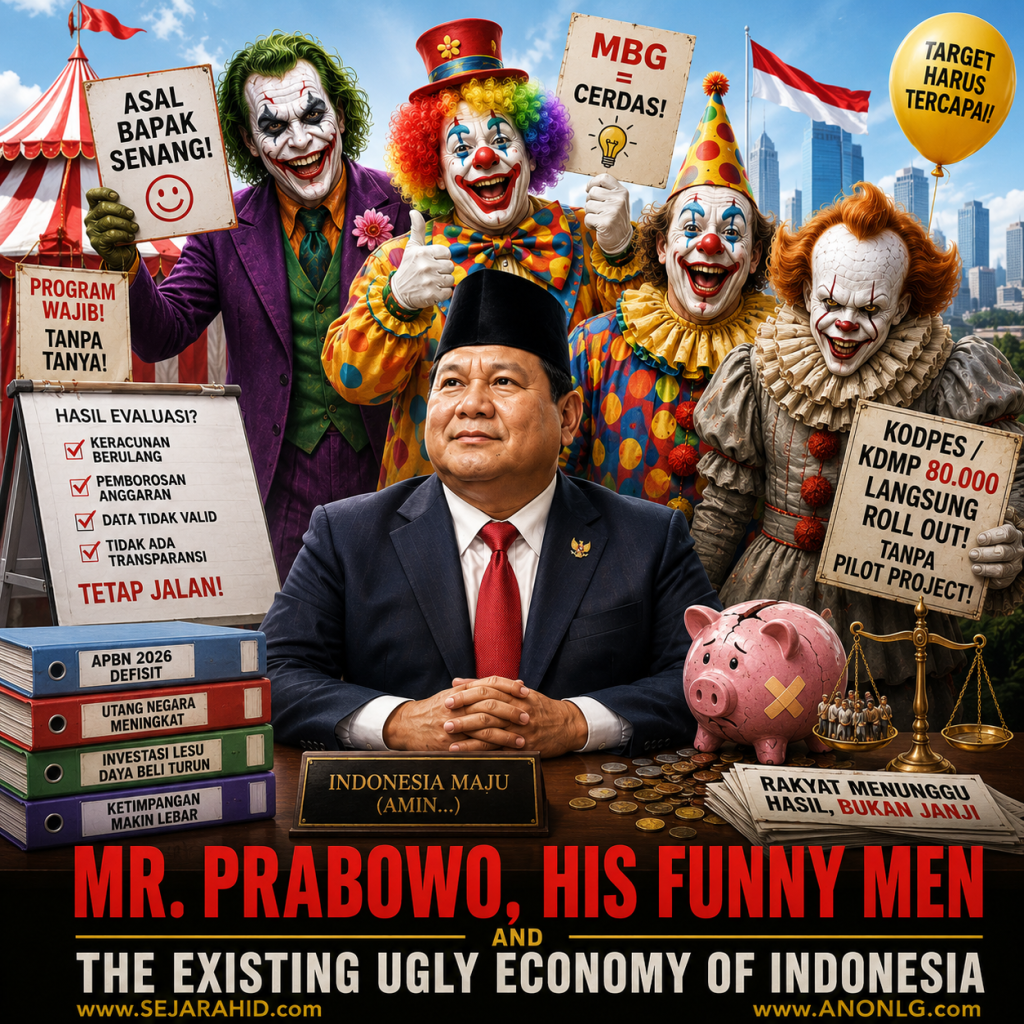
Editor’s Note: A 30-Part Deep Dive into Indonesia’s Economic & Political Landscape
What you are about to read is more than just a single essay—it is the master framework for a comprehensive, 20-to-30-part investigative series published on SEJARAHID.com and or ANONLG.com.
This piece serves as the introductory framework for a series of 20 to 30 analytical articles published on SEJARAHID.com. The collection examines the economic, political, and institutional policy directions under the administration of President Prabowo Subianto.
Rather than looking at these initiatives in isolation, the series analyzes the political calculus and structural mechanics driving current national policy. Key themes covered across the collection include:
- The MBG & SPPG Crisis: The mechanics of food safety failures, the systemic displacement of school canteens, and the legal liabilities facing the state.
- KOPDES & Economic Sovereignty: Why selling instant noodles won’t save rural Indonesia, and how a closed-loop “Mandate Distribution System” could transform local cooperatives into multi-billion Rupiah economic powerhouses.
- Economic Reality Checks: Hard comparisons between Indonesia and regional peers, analyzing Pertamina vs. Petronas, teacher salaries, hyper-inflated higher education costs, and persistent poverty.
- The Military Budget & Security Alignment: The economic consequences of military expansion and the troubling reliance on street-level paramilitary organizations like GRIB Jaya in the eyes of foreign investors.
Each article in this series provides data-driven analysis, legal critiques, and alternative policy blueprints designed to separate political distraction from genuine national strategy.
The Economy Was Broken Long Before Prabowo
To be fair, blaming Indonesia’s ugly economy entirely on Prabowo Subianto is just wrong. The country’s economic engine was sputtering long before he ever took the oath of office.
When I entered the Faculty of Mathematics and Natural Sciences at Universitas Indonesia (FMIPA UI) back in 1992, my tuition was just IDR 250,000 a semester. Today, a student walking into that same faculty gets slapped with a bill between IDR 15 million to 17 million. That isn’t just inflation—that’s a structural breakdown. Our wages haven’t grown anywhere near that scale over the last thirty years, yet the cost of living and education have shot straight to the moon.
You only have to look across the border to Malaysia to see how far behind we really are. In Malaysia, a public school teacher can earn anywhere from 8 million to 20 million Rupiah a month, enough for a solid middle-class life. On the corporate side, look at the 2024 numbers: Malaysia’s state oil company, Petronas, pulled in RM 55.1 billion (around IDR 182 trillion) in net profit. Meanwhile, Indonesia’s Pertamina managed just USD 3.13 billion (around IDR 49 trillion)—even though Pertamina brought in higher total revenue (IDR 1,175 trillion vs Petronas’ IDR 1,056 trillion) and we have nearly eight times the population. The reality is, our economy has been structurally behind for decades.
At home, the warning signs have been flashing red for years:
- The Rupiah: Sitting past 15,000 per USD, constantly eating away at people’s buying power.
- No Jobs: Finding a decent, stable job has become a nightmare for millions of young college grads.
- Life on Hold: Because money is so tight, more and more young adults are putting off getting married or starting a family.
- Falling Apart: Rural school roofs are literally leaking while we face a massive shortage of teachers—mostly because we refuse to pay the people who build our kids’ future a proper wage.
From “Yo Ndak Tahu” to “Foreign Stooges”
Even though Prabowo inherited a broken house, the way his administration handles criticism is a whole different story compared to his predecessor.
Under Jokowi, the go-to strategy when things went wrong was playing clueless. Facing a crisis, his team relied on passive answers, framed by the famous “Yo ndak tahu” (I wouldn’t know) or an endless routine of looking “surprised” by basic problems:
- Jokowi Mengaku Kaget Dapati Harga Beras dan Bawang di Sulawesi Lebih Murah dari Jawa
- Jokowi Kaget Rasio Warga Berpendidikan Tinggi di RI Masih Rendah
- Jokowi Kaget Ada Wacana Iuran Dana Pensiun Tambahan, ‘Itu Potongan Apa Lagi?’
It was performative shock—acting as if the President were just a confused bystander instead of the guy running the country.
The Shift Under Prabowo
Prabowo, on the other hand, doesn’t play dumb. He gets defensive.
His cabinet ministers mostly act as an echo chamber, agreeing with whatever the boss says without pushing back. And when real economic pain or policy failures get called out, the official response quickly turns paranoid. Instead of fixing the policy or admitting a mistake, the reflex is to accuse critics and frustrated regular people of being antek-antek asing—foreign stooges out to ruin the country.
- Aparat bungkam jurnalis dan aktivis dengan narasi antek asing, sebut laporan
- Negara tuduh pendemo “antek asing”: Retorika politik Prabowo untuk bungkam suara rakyat
MBG and KOPDES: Big Promises, Half-Baked Execution
Prabowo’s flagship programs aren’t just policy—they are political survival tools. Holding only a small share of parliament (Gerindra has just 14.83% of the seats), Prabowo knows he needs a direct line to everyday voters to build a base for 2029.
That is why he launched two massive initiatives: the Free Nutritious Meal (MBG) program and the Red and White Village Cooperative (KOPDES / KDMP). But while the ideas sound grand on paper, the real-world execution has been deeply flawed.
1. The MBG Poisoning Crisis vs. (Topeng Monyet)
MBG and its local service units (SPPG) were sold as a revolutionary way to keep kids healthy and smart. Instead, since 2024, the program has made headlines for endless waves of mass food poisoning across Java, Sumatra, and Sulawesi.
Worse, instead of helping local vendors, these centralized kitchens are shutting out traditional school canteens and taking away the livelihoods of everyday canteen workers.
The causes of the poisonings aren’t a secret:
- Insane Schedules: Food is routinely cooked at 9:00 PM the night before to be served at 9:00 AM the next morning. That means warm food sits in the bacterial “danger zone” for 12 straight hours.
- Rotten Ingredients: Vendors use stale or wilted produce—mixing old stock or buying cheap, near-spoiled ingredients just to cut costs and pocket a bigger margin.
It makes you ask a ridiculous question: if we trained street performance monkeys—(Topeng Monyet)—to cook these meals, who would cause more food poisoning? The official SPPG or the Topeng Monyet?
At least a Topeng Monyet has biological instincts and won’t touch food that smells rotten. The human operators running these broken supply chains suffer from pure moral hazard—deliberately cooking bad food hours too early just to hit targets and save a buck.
2. KOPDES: A Neighborhood Grocery vs. Real Village Power
At the same time, KOPDES (or KDMP) was pushed out without proper pilot projects or real supply chain planning. Instead of becoming a power center for village economies, it has turned into a glorified roadside shack selling low-margin stuff like instant noodles, soy sauce, soap, and detergent.
Setting up thousands of unintegrated corner stores without a real plan is a recipe for bankruptcy within a year. Comparing what KOPDES is now to what it could be is like comparing a guy selling snacks on the side of a toll road to the company that owns the toll gate. One is fighting for pennies; the other controls the actual economic traffic.
If the government actually wanted to build village power, KOPDES wouldn’t be selling sachets of shampoo. It would operate under a Mandate Distribution System—getting exclusive rights to supply major materials like cement, fertilizer, and bricks, or serving as the exclusive supplier of eggs, chicken, and veggies to local MBG kitchens. Without that kind of structure, KOPDES is just another political monument waiting to go broke.
The Danger of Street-Level Muscle
By handing out free meals and setting up village shops, Prabowo is trying to lock in grassroots loyalty early for the next election cycle, leaving political rivals like Anies or Ganjar sitting on the sidelines. But this strategy carries a huge risk.
Beyond the bad economics, Prabowo’s ongoing connection to street-level paramilitary groups—specifically his position as Chairman of the Board of Trustees for GRIB Jaya, led by figures like Hercules—is a massive red flag.
Having a private “rapid response unit” might seem useful for political intimidation, but their history of burning cars, fighting with police, and forcing factory shutdowns terrifies investors. Serious domestic and foreign capital won’t stay in a country where street gangs hold that kind of power. As the economy gets tighter and jobs get scarcer, political opponents won’t even need to attack Prabowo’s promises—they just have to point to the growing lawlessness and capital flight.
Summary: Real Strategy or Just Distraction?
Indonesia’s economic mess runs deep, and we can’t afford half-baked policies wrapped in populist slogans.
As regular people struggle with stagnant pay, crazy university bills, and a dead job market, nobody is looking for Jokowi’s old “surprised” routine. Nor do they want half-cooked programs that send school kids to the emergency room or turn village economies into noodle stands. And they certainly don’t appreciate being called foreign traitors just for asking for a working economy.
Whether it’s MBG or KOPDES, throwing messy programs at the public to build political loyalty isn’t a strategy to fix the country—it’s just a distraction. History will remember whether this administration actually tried to build a real economy, or if it was just running a five-year campaign at the public’s expense.